
The experiences and struggles of LGBTQIA+ people of color (QTPOC) are often forgotten – especially when people fail to recognize what life is like at the intersection of those identities.
That’s why this comic’s message is so important. Learn about the impact of factors like gendered racism, fetishization, and violence targeting queer people of color, and you’ll understand why we need to address how various forms of oppression multiply each other.
This will also help you understand how to support LGBTQIA+ people of color – starting with the reminder to “just trust us when we tell our stories.”
With Love,
The Editors at Everyday Feminism
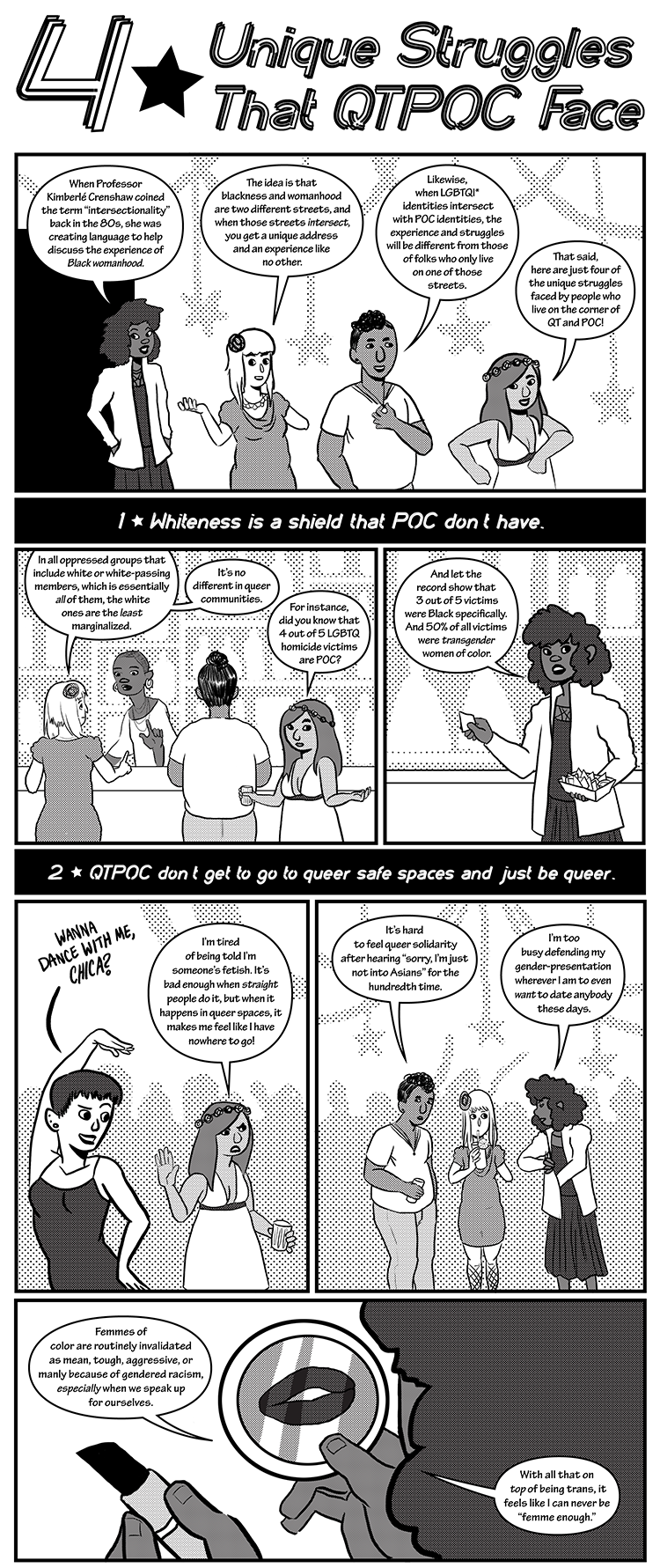
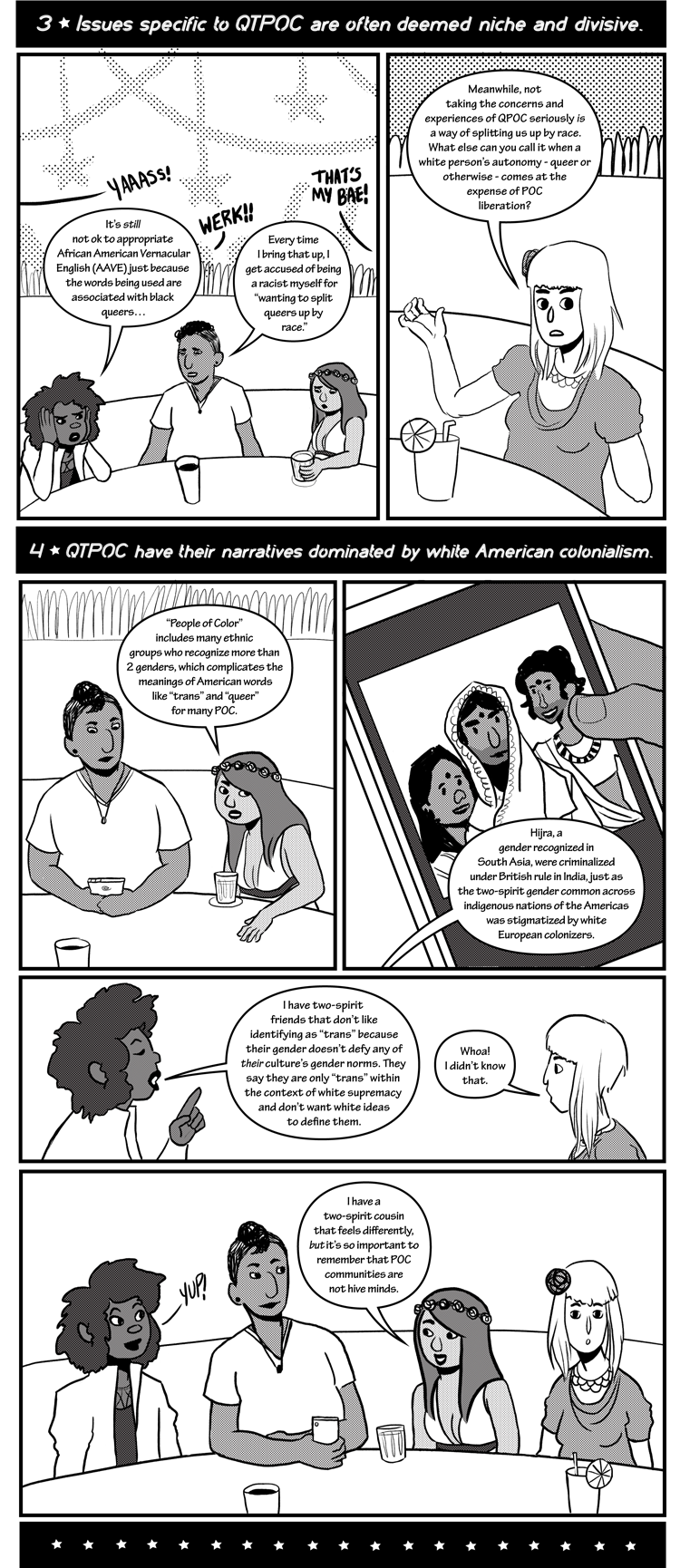
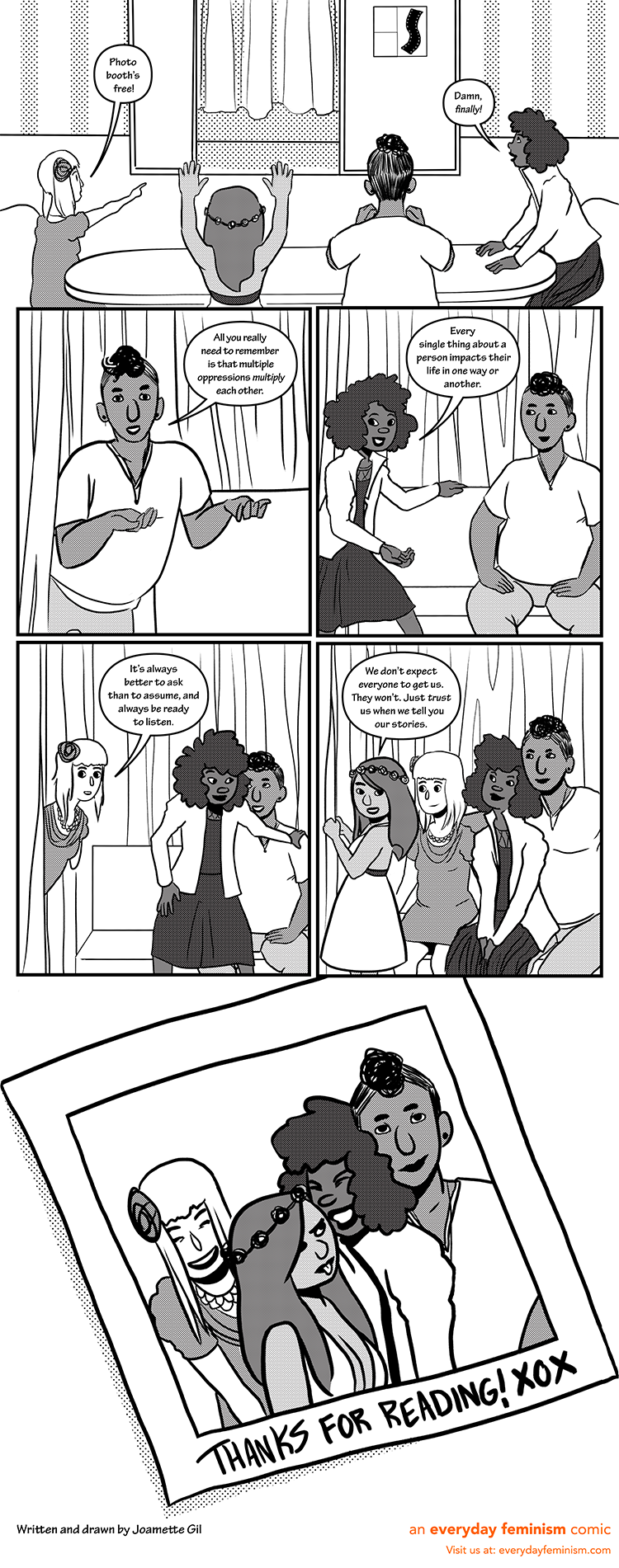
Three QTPOC and their White Friend are entering a queer party. QPOC 1 is Mestiza, QTPOC 2 is a non-binary South Asian, QTPOC 3 is a Black trans woman, and White Friend has one arm. They are all looking the reader’s way. QTPOC 3: When Professor Kimberlé Crenshaw coined the term “intersectionality” back in the 80s, she was creating language to help discuss the experience of Black womanhood. White Friend: The idea is that blackness and womanhood are two different streets, and when those streets intersect, you get a unique address and an experience like no other. QTPOC 2: Likewise, when LGBTQIA+ identities intersect with POC identities, the experience and struggles will be different from those of folks who only live on one of those streets. QPOC 1: That said, here are just four of the unique struggles faced by people who live on the corner of QT and POC! Text: #1 – Whiteness is a shield, and POC don’t have it. Our cast is gathered at the bar. White Friend: In all oppressed groups that include white or white-passing members, which is essentially all of them, the white ones are the least marginalized. It’s no different in queer communities. QPOC 1: For instance, did you know that 4 out of 5 LGBTQIA+ homicide victims are POC? QTPOC 3 is gesturing at the audience with a nacho chip, a bowl with more chips in their other hand. QTPOC 3: And let the record show that 3 out of 5 victims were Black specifically, and 50% of all victims were transgender women of color. Text: #2: Queer POC don’t get to go to queer “safe spaces” and just be queer. QPOC 1 and White Friend are walking into the party crowd, QPOC 1 has a hand raised as if to say “no way” to a different white queer who is ogling her. QPOC 1: I’m tired of being told I’m someone’s fetish. It’s bad enough when straight people do it, but when it happens in queer spaces, it makes me feel like I have nowhere to go! QTPOC 2 and QTPOC 3 are sticking close together in the crowd. QTPOC 3 is reaching in her purse. QTPOC 2: It’s hard to feel queer solidarity after hearing “Sorry, I’m just not into Asians” for the hundredth time. QTPOC 3: I’m too busy defending my gender presentation wherever I am to even want to date anybody these days. QTPOC 3 is checking her lipstick in compact mirror. QTPOC 3: Femmes of color are routinely invalidated as mean, tough, aggressive, or manly because of gendered racism, especially when we speak up for ourselves. With all that on top of being trans, it feels like I can never be “femme enough.” Text: #3: Issues specific to QTPOC are often deemed “niche” and “divisive.” The friends sit at a table together. In the background, some random white queers are dancing and happily shouting words like “yaaas” and “werk, gurl” and “that’s my bae!” QTPOC 3: (Arms crossed, looking uncomfortable.) It’s still not okay to appropriate African American Vernacular English (AAVE) just because the words being used are associated with black queers… QPOC 1: (Doing scare quotes with her hands while rolling her eyes.) Every time I bring that up, I get accused of being a racist myself for “wanting to split queers up by race.” White Friend stirs their drink with a straw. White Friend: (Looking at reader.) Meanwhile, not taking the concerns and experiences of QPOC seriously is a way of splitting us up by race. What else can you call it when a white person’s autonomy – queer or otherwise – comes at the expense of POC liberation? Text: #4: Queer POC have their narratives dominated by white American colonialism. Focus on QTPOC 2 and QPOC 1, who are sitting next to each other. QPOC 1 is looking something up on her phone. QTPOC 2: “People of Color” includes many ethnic groups who recognize more than two genders, which complicates the meanings of American words like “trans” and “queer” for many POC. Focus on QPOC 1’s smart phone as she shows the reader the headline of an article about hijra identity in India, including a picture. QPOC 1: Hijra, a gender recognized in South Asia, were criminalized under British rule in India, just as the two-spirit gender common across indigenous nations of the Americas was stigmatized by white European colonizers. Focus on QPOC 3 and White Friend sitting by each other. QTPOC 3: I have two-spirit friends that don’t like identifying as “trans” because their gender doesn’t defy any of their culture’s gender norms. They say they are only “trans” within the context of white supremacy and don’t want white ideas to define them. White Friend: (White Friends looks surprised but receptive.) Whoa! I didn’t know that. The whole cast sitting at their booth together. QTPOC 3 is smiling in acknowledgement of QPOC 1’s words. QPOC 1: I have a two-spirit cousin that feels differently, but it’s so important to remember that POC communities are not hive minds. White Friend points out a photo booth across from their table with people exiting from it. Our whole cast looks excited. White Friend: Photo booth’s free! QPOC 1: Damn, finally! QTPOC 2 climbing into the photo booth while reader is seeing this from the camera’s perspective. QTPOC 2: (Looking into the camera.) All you really need to remember is that multiple oppressions multiply each other. QTPOC 3 is sitting down inside the photo booth while QPOC 2 scoots over. QTPOC 3: (Looking into the camera.) Every single thing about a person impacts their life in one way or another. White Friend is squeezing in, QTPOC 3 moving to sit on QTPOC 2’s lap. White Friend: It’s always better to ask than to assume, and always be ready to listen. QPOC 1 hops on White Friend’s lap (everyone is happy and okay with all this lap-sitting). QTPOC 1: We don’t expect everyone to get us. They won’t. Just trust us when we tell you our stories. The last panel is a cute photo of the cast with a star border and the words “Thanks For Listening!” at the bottom.Click for the Transcript
Panel 1
Panel 2
Panel 3
Panel 4
Panel 5
Panel 6
Panel 7
Panel 8
Panel 9
Panel 10
Panel 11
Panel 12
Panel 13
Panel 14
Panel 15
Panel 16
Panel 17
Panel 18
Panel 19
Panel 20
Panel 21
Panel 22
To learn more about this topic, check out:
- 3 Reasons Queer Asians Can’t Discard Their Families – And Why They Don’t Have to
- Wedding Bells and Prison Bars: Why Prison Abolition Is a Queer Rights Issue
Joamette Gil is a queer Afro-Cuban storyteller with a degree in social justice and psychology. Her comics and illustrations straddle the border between personal and political, reality and fantasy, what is and what is possible. The Miami native now lives and makes in Portland, OR, and you can follow her adventures here.