You might know about the type of non-monogamy that gets most mainstream media attention. But do you know about these other relationship styles outside the status quo?
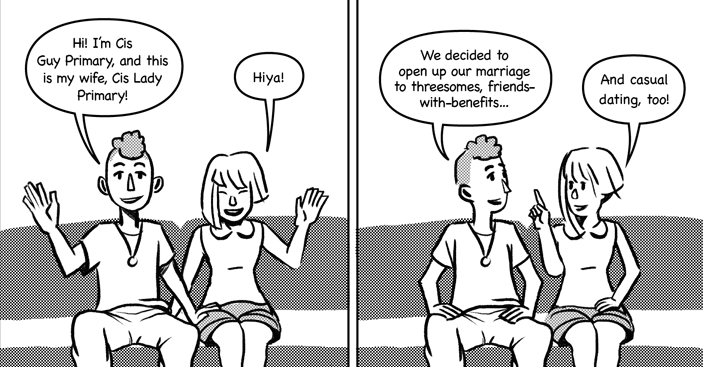
This comic sheds light on the types of non-monogamy that tend to get ignored.
Whether non-monogamy’s for you or not, you can probably learn something from these examples of how people create options to put feminist values at the core of their relationships and reject oppressive expectations.
Do they challenge what you think a healthy partnership means?
With Love,
The Editors at Everyday Feminism


This is a caption box that stretches over Panels 2 and 3. Text: Most mainstream media only talks about a very specific type of non-monogamy. A happy couple sits in a modern/professional-looking living room while holding hands and waving at the reader as if facing a camera. Guy: Hi! I’m Cis Guy Primary, and this is my wife, Cis Lady Primary! Lady: Hiya! Same as Panel 2, without the waving. Guy: We decided to open up our marriage to threesomes, friends-with-benefits… Lady: And casual dating, too! Similar to the first couple of panels, except Lady is holding up her fists in a gesture of pride and power. Both look cheerful, like they’re enjoying themselves. Narrator: It’s super great that open relationships like these are being acknowledged outside of subcultural circles, and that monogamy is a little closer to losing its mythical status as “the only true way to be in love.” Lady: We’re proudly challenging the status quo! Similar panel, this time Guy looks completely thrown-off and Lady is leaning far forward, eyebrow quirked in suspicion. Narrator: The only problem is that, compared to other forms of non-monogamy, this one doesn’t do much at all to challenge the status quo. Guy: Wait, what? Lady: Yeah, what’s that supposed to mean? This is a caption panel that spans the width of the comic. Narrator: To be more specific, here are five styles of non-monogamy with feminist principles at their core that the mainstream either ignores or doesn’t take seriously. A black woman gestures at a black man and an indigenous man holding each other lovingly and looking at her with affection. Text: Number 1: Styles that center queer love. Black Woman: My husband’s boyfriend of 7 years is no less primary than I am! An East Asian man wearing an apron holds hands with a white trans man as a brown genderqueer person heads off to an office job. Text: Number 2: Styles that challenge gender norms. East Asian Man: I’m a homemaker while my genderqueer partner works to support us! White Trans Man: That includes me! I’m partnered with both of them. A black man (shrugging casually) and a desi woman (in a wheelchair, arms akimbo) smile approvingly at another desi woman and a brown Latina (center, staring into each other’s eyes). Text: Number 3: Styles that don’t police sexual or romantic desire. Black Man: It’s not up to me how many people she falls in love with! Desi Woman 1: We’re in love, but we don’t wanna have sex. Desi Woman 2: I’m aromantic and plan to spend the rest of my life with her! A family of five huddled together, adults in a line and the child in front holding a loaf of bread. Text: Number 4: Styles that allow alternatives to the nuclear family. Parent 1: I gave birth to them! Parent 2: I helped create them! Parent 3: I tuck them into bed every night! Parent 4: I taught them how to read! Kid: We always eat dinner together! Two brown people having a heartfelt conversation, both teary-eyed. Text: Number 5: Styles that encourage autonomy. Brown Woman: I want to be together forever so long as we’re never stopping each other from following our hearts or hurting each other. Brown Man: Likewise! And if you happen to leave me after falling for someone new, I trust you enough to know it’s because our needs don’t match anymore. I know you wouldn’t use me. Primary couple looks just a little defensive but not upset. Cis Guy has a slightly smug smile, and Cis Lady has her arms crossed. Cis Guy: Okay, those are definitely more “off-beat” than what we’re doing, but how does that make our style less challenging to the norm? Cis Lady: Yeah, why compare? Someone could really learn from hearing any one of our stories! Close-up of Cis Lady looking up at the caption box as if speaking to it directly, a hesitant smile on her face as she relaxes a little. Narrator: You’re totally right! Cis Lady: I am? Narrator: Of course! The story of your style is a sort of “gentle nudge.” It’s probably gotten a lot of people to think outside the box in terms of how they live in relation to others. This is a caption panel that spans the width of the comic. Narrator: But there is a reason why the mainstream likes telling your story in particular. The classic “male” and “female” symbols (venus and mars) inside of a heart. Narrator: When the faces of stable, healthy, polyamorous relationships are cisgender, heterosexual couples, it’s easier for the most privileged couples to see themselves mirrored back. Consequently, there is less need for monogamous people in positions of power to question the relationship’s legitimacy or challenge their own bias.For example, we have to ask ourselves, why don’t these articles include the voices of secondary partners? Black silhouette of a nude DFAB sitting on the ground, resting arms on knees. Narrator: Our culture expects people to grant “the one” exclusive access to their body and as well as a say in who touches it, how, and when. While granting a partner this privilege isn’t wrong, imagine if more people felt invited to question this norm. For example, how many women currently see it as a privilege they are granting someone as opposed to an obligation they are under? Another caption panel that spans the width of the comic. Narrator: Meanwhile, some forms of non-monogamy can make it difficult, if not impossible, for people to access some basic privileges such as Brown trans woman standing between two partners. Narrator: Marriage. Brown Trans Woman: I don’t want to be married to just one of them, but marrying both could land me in prison. Three miffed-looking parents with a kid. Narrator: Adoption. Parent 3: I’ve co-parented Sol since she was born, but the state only lets her have two legal guardians. A poly family of four looks frustrated as they discuss a rental app with a leasing agent. Narrator: And housing. All at Once: But we do make more than three times the rent if you combine our incomes! Agent: Sorry, we only count married couples’ incomes as one income. Cis Guy is looking down thoughtfully with his arms crossed, leaning back. Cis Lady shrugs a little helplessly, looking concerned/confused. Narrator: All while being told that their partnerships are frivolous and destined to fail. Not to mention that these disadvantages are going to affect people with multiple marginalized identities the most! Cis Guy: Hm. I guess I never thought it was possible for any non-monogamous relationship could have privilege. Cis Lady: Yeah. Me neither. But what can we do about it? The Primaries look hopeful and eager to help. Narrator: Share the spotlight! Next time someone comes to you asking about non-monogamy, make sure they understand that your way isn’t the only way and that some of the possibilities are downright revolutionary. Cis Lady: We can totally do that!Click for the Transcript
Panel 1
Panel 2
Panel 3
Panel 4
Panel 5
Panel 6
Panel 7
Panel 8
Panel 9
Panel 10
Panel 11
Panel 12
Panel 13
Panel 14
Panel 15
Panel 16
Panel 17
Panel 18
Panel 19
Panel 20
Panel 21
Panel 22
To learn more about this topic, check out:
- More Than Two: Examining the Myths and Facts of Polyamory
- So You Think You’re Polyamorous: A Guide to Coming Out to Yourself
Joamette Gil is a queer Afro-Cuban storyteller with a degree in social justice and psychology. Her comics and illustrations straddle the border between personal and political, reality and fantasy, what is and what is possible. The Miami native now lives and makes in Portland, OR, and you can follow her adventures here.