Originally published on Empathize This and republished here with their permission.
Does getting married change someone’s bisexuality?
It’s a common assumption that once someone “settles down” with a partner of one gender, their attraction to people of other genders is just for fun – or nonexistent.
Here’s one woman’s description of how these assumptions feel. Her story will show you why it’s not okay to minimize your partner’s bisexuality – and what she wishes her relationship was like instead.
With Love,
The Editors at Everyday Feminism

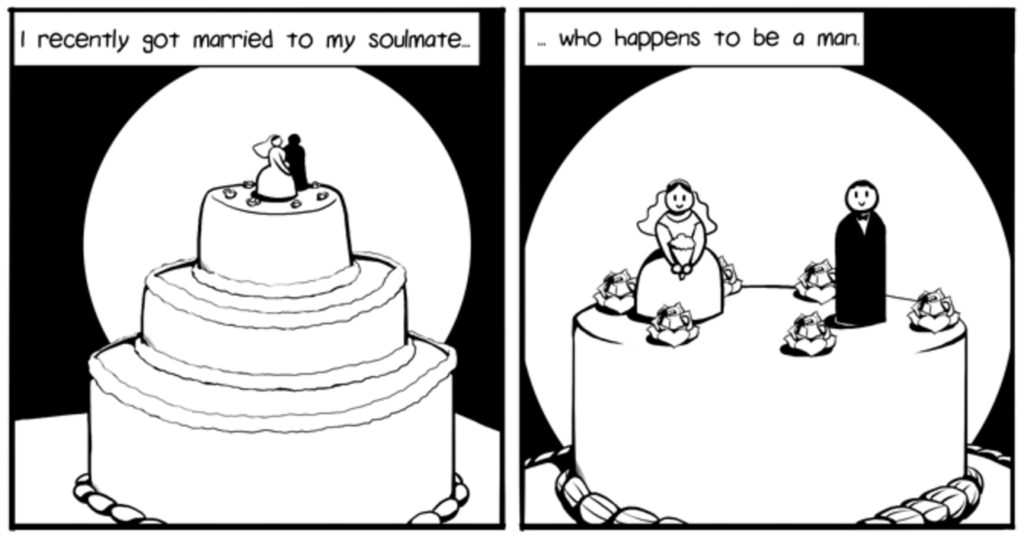
It took me a long time to accept that I am bisexual. And even though I still feel like that single word doesn’t encompass the spectrum of my sexuality, I use it because it saves me time from going into an in-depth conversation with people who I don’t owe any explanations to. I recently got married to my soul mate, who just so happens to be a man. I was honest from the start of our relationship about my attraction to both men, women, and anyone in between. It didn’t matter to him and we fell in love. But sometimes it seems like he forgets that side of me. When we discuss hypothetical situations regarding infidelity he’ll say things like “if you cheat on me with some guy,” or “don’t go cheating on me with another man.” While I would never cheat on him, I like to point out that it doesn’t necessarily need to be a man. I like women too! I also notice that he pays close attention to if I check out a guy but pays no mind if I check out a woman. I don’t think he realizes how his disregard for my different attractions affects me. It makes me feel like there is a part of me that is invisible to him. In order to be monogamous, I may look like I am attracted to just one gender, but that doesn’t make it true. Bisexuals do not “pick” or “end up on one side or the other.” I am bisexual, and my hope is for the man I love to fully understand and respect that.Click for the Transcript
To learn more about this topic, check out:
- Here’s What Happens When We Erase Bisexuality – And How You Can Be a Better Ally
- 8 Relationship Reminders for Bisexual Women That You Don’t Get Nearly Enough
Empathize This develops comics based on audience-submitted stories about how prejudice and hardship affect their lives. They believe that a visual element helps some people understand a story better, that having the comic can help drive the narrative’s point home. Please follow them on twitter at @empathizethis.