(Content Warning: Ableism, eating disorders)
Ever told someone “at least you have your health?”
This phrase may be well-meaning, but you might not realize that it’s actually an ableist assumption. Find out how with this insightful comic. This author breaks down what it’s like to have an invisible illness, what health really means, and what you’re missing if you use appearance to judge whether or not someone’s healthy.
Making this change to your understanding of health can make a big difference for people with invisible illnesses.
With Love,
The Editors at Everyday Feminism

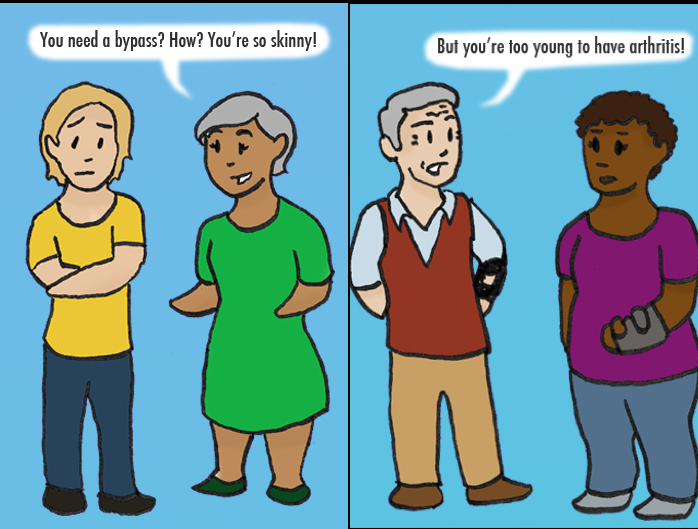
(The cartoonist, Alli, holding a cane and an inhaler, speaking to the reader) Alli: I’m Alli, and I live with invisible illnesses, including asthma, Celiac Disease, and arthritis. Invisible illnesses can be daunting to cope with because you live not only with your illness/es, but also with constant questioning and challenging of your illness. So today we’re going to talk about what health is and why we need to stop using appearances to gauge health. (A woman speaking to a thin person who looks uncomfortable) Woman: You need a bypass? How? You’re so skinny! (Alli gesturing to two outlines of people, one fat and one thin) Alli: “Thin” is not the same thing as “healthy,” and “fat” is not the same thing as “unhealthy.” Assuming that thin people must be healthy not only complicates invisible illness, it also perpetuates fat shaming. This is tremendously dangerous because weight loss is often a symptom of illness and yet, because of how fatphobic our culture can be, it is more frequently a treated as a cause for celebration than concern. (An older man speaking to a younger woman whose hand is in a brace.) Older man: But you’re too young to have arthritis! (Alli looking perplexedly at her cane) Alli: Anyone of any age can have chronic pain, though it is most frequently associated with older people. Youth isn’t synonymous with health, and being older doesn’t mean a person is expected to be sick. The assumption that chronic pain is an older person’s problem is both ableist and ageist. (A white man speaking to a Latinx woman who looks angry.) Man: Sickle Cell Anemia…? But I thought… Woman: Thought what? Man: … I thought only Black folks got that. (Alli, looking grumpy holding up a handful of flame) Alli: If someone discloses an illness to you do this: First, believe them; second, write down all your preconceived notions and burn them. In a world more diverse than ever before, race-based assumptions grounded in the science of the last century are very damaging. (Two men, one looks startled and is speaking.) Man: How can you be bipolar? You have such a stable family. (Alli holding a bottle of pills) Alli: Slow down, Turbo. The belief that mental illnesses only occur for people from “unstable” backgrounds is hella classist and perpetuates mental illness stigma. Mental illnesses can be caused by everything from stress to trauma to just brain chemistry, so pretty much everyone is at risk for mental illness. (A thin woman speaking to a fat man) Woman: Haha, no offense, but you don’t really look like the kind of person who has to worry about an eating disorder. (Alli frowning and crossing her arms) Alli: Fuck no. No, no, no. Don’t say shit like this. Eating disorders can affect anyone, and by marginalizing fat ED sufferers because you think only thin people have EDs, you’re putting lives at risk and fat shaming in a way that is more repugnant than I have words for. (Alli shrugging) Alli: Anyway, the ableist assumption at the bottom of this is that all sick people look sick and all well people look well, which just isn’t true. That assumption is why the phrase “Well, at least you have your health” is so reviled in invisible illness communities – you don’t have an MRI in your skull or a spectrometer on your face – you have no idea about the health of whomever you’re speaking to. (Alli wearing a western-style shirt and holding a guitar) Alli: “At least you have your health” is like a punchline in a country song – last ditch comfort for when your significant other leaves you the same day your dog dies. But invisibly ill people don’t have their health and you’ve just given them a reminder that they can’t even reach your baseline for misery and that you have no idea they’re ill and might not believe them if they told you. (Alli leaning on her cane and smirking) Alli: So, please, don’t make assumptions about health (either wellness or illness) based on how someone looks – not everyone who is sick looks “sick,” and not everyone who looks “healthy” is healthy. And please believe people when they say they’re sick. Assuming that you have any right to question someone’s admission of illness is one of the more disconcerting forms of ableism that gaslights and others people who are ill. When you do this, you’re calling out the speaker as a liar, so don’t be surprised if they turn it around and call you out as ableist.Click for the Transcript
Panel 1
Panel 2
Panel 3
Panel 4
Panel 5
Panel 6
Panel 7
Panel 8
Panel 9
Panel 10
Panel 11
Panel 12
Panel 13
Panel 14
To learn more about this topic, check out:
- How Mainstream Feminism Continues to Perpetuate Ableism (And How We Can Change That)
- 10 Ways to Avoid Everyday Ableism
Alli was a Contributing Comic Artist for Everyday Feminism from 2015 to 2017. They are the creator of the webcomic PunkPuns and the vocalist of the L.A. queer feminist punk band P.I.T. Alli has a degree in English Literature, which is cheerfully wasted in pop literary criticism discourse on Tumblr.