(Content Warning: anti-black racism, ableism, fat shaming, anti-Muslim rhetoric, anti-queer rhetoric)
How can we understand oppression, and what we can do to put a stop to it? Here’s a comic that makes a great foundation for the conversation.
This breaks down the difference between prejudice, discrimination, and oppression – with examples of exactly how they can show up in our lives.
And the best part is that it shows that things don’t have to be this way. You can also find out how to address these issues in our activism and our everyday lives.
Here’s to moving toward a better world where we can all understand these issues, and how to build healthier cycles!
With Love,
The Editors at Everyday Feminism

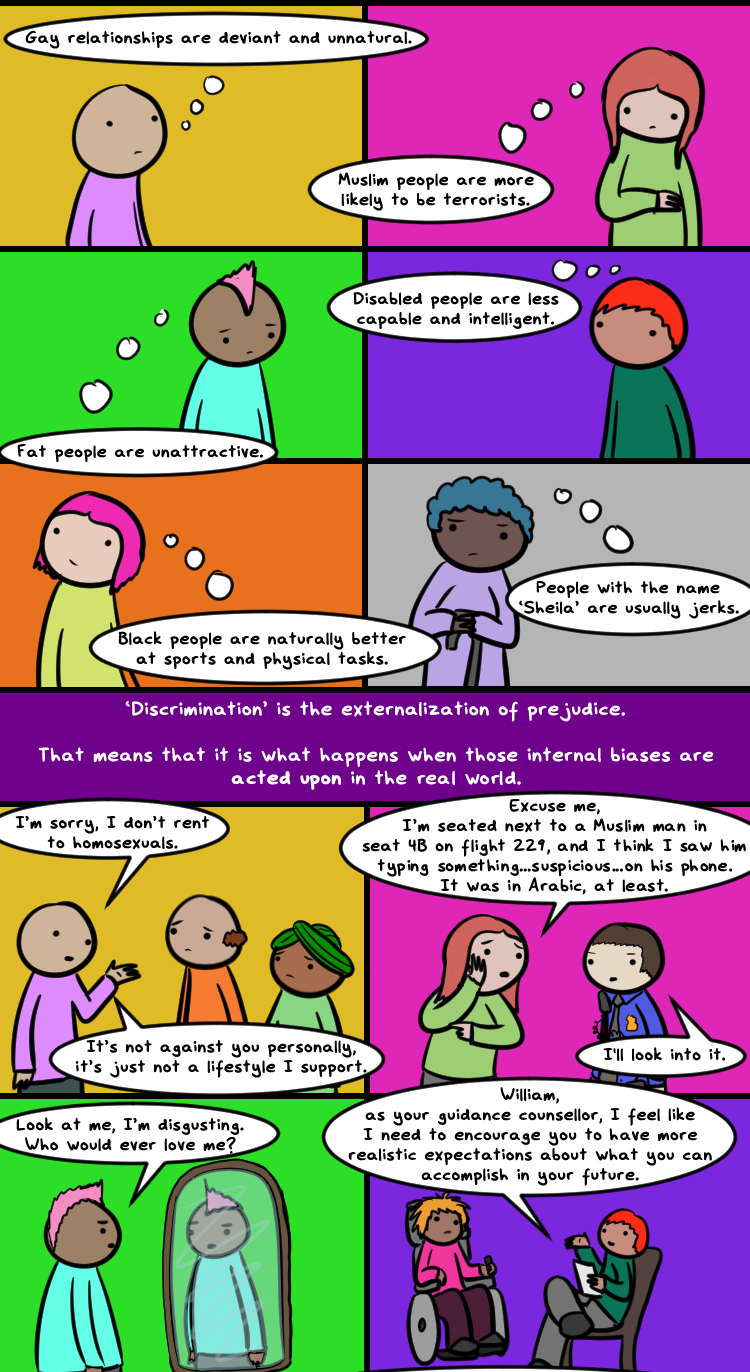
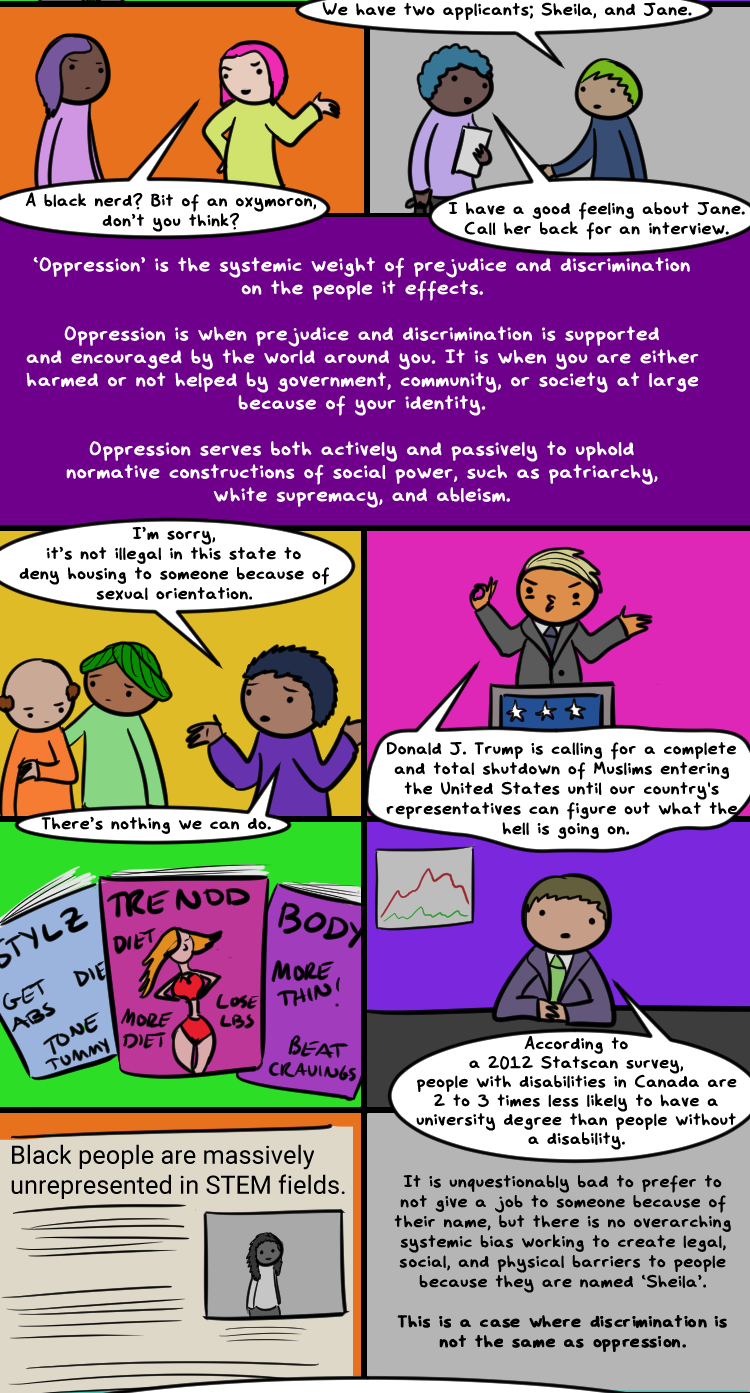
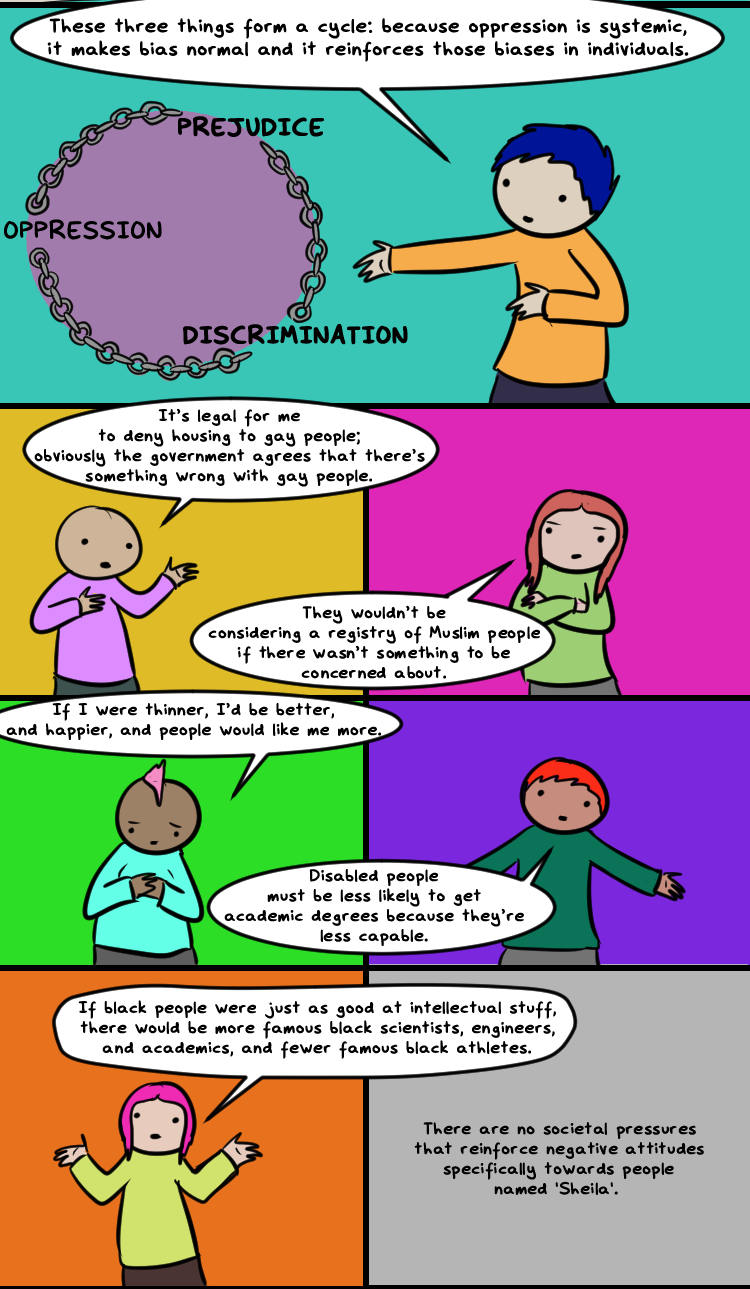
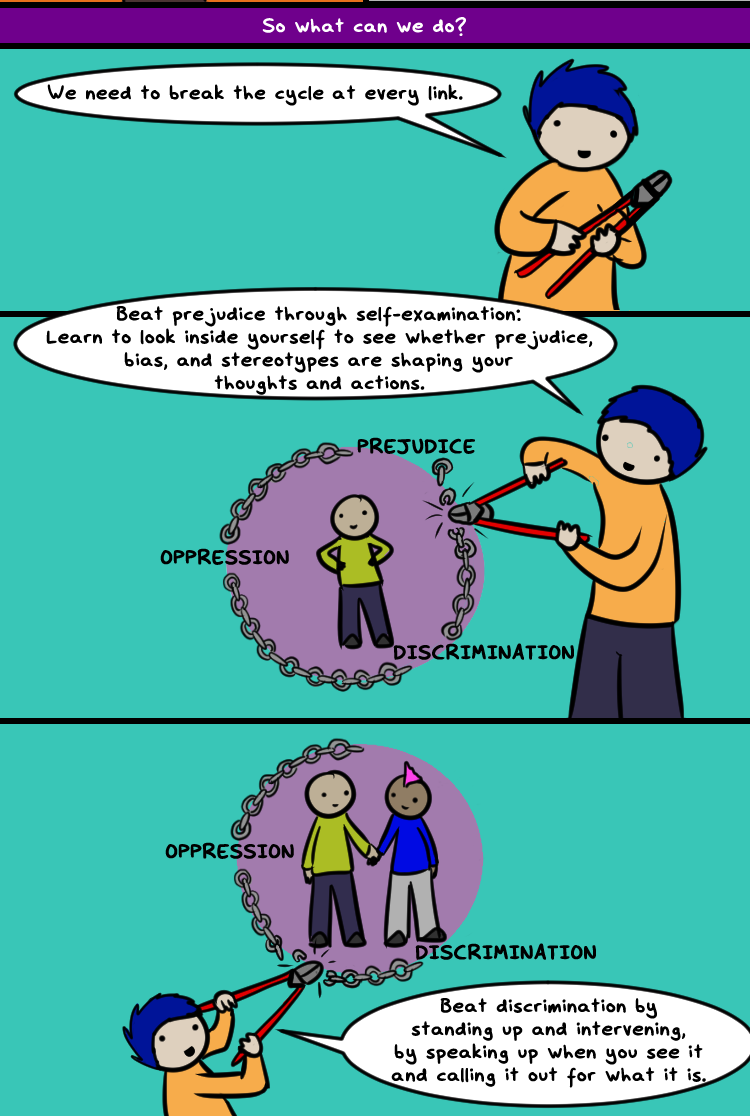
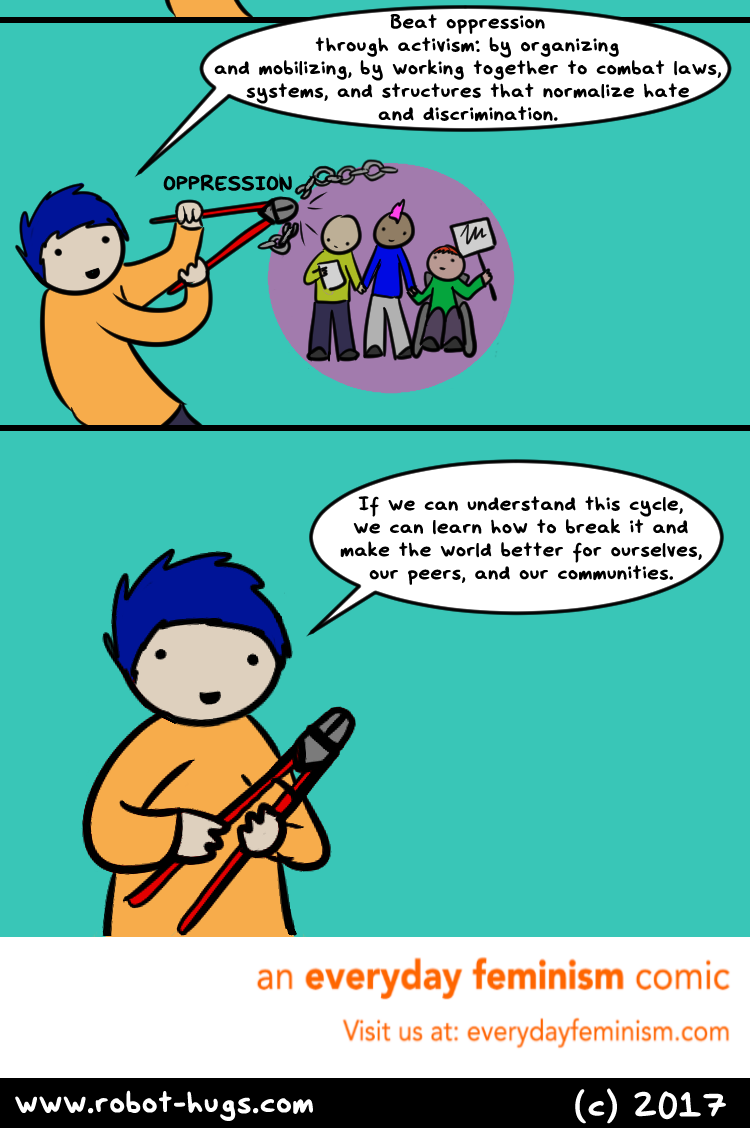
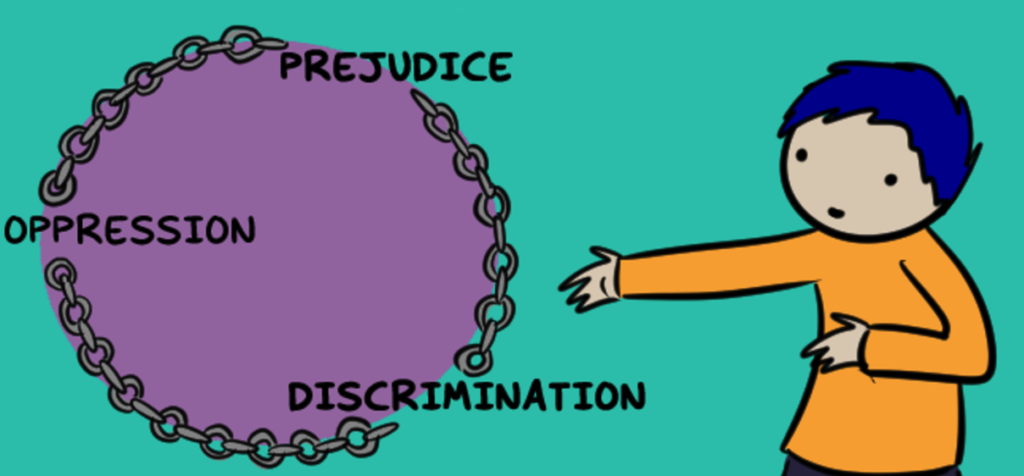
Text: What’s the difference between prejudice, discrimination, and oppression? (Robot Hugs is talking.) Robot Hugs: Well, what is the difference between the terms prejudice, discrimination, and oppression? They do tend to show up together, don’t they? (RH is talking.) RH: Well, while they have related meanings, they’re actually describing specific things. Text: Prejudice is referring to internally held biases. These are preconceived opinions and emotions that live inside your head about individuals or groups, and they can be both positive and negative. Everyone has prejudiced thoughts, even about groups they belong to. Prejudice is often unconscious – you aren’t always aware of the biases and preconceptions that are influencing you. (Arvind is thinking.) Arvind: Gay relationships are deviant and unnatural. (Jeanette is thinking.) Jeanette: Muslim people are more likely to be terrorists. (Steph is thinking.) Steph: Fat people are unattractive. (Jake is thinking.) Jake: Disabled people are less capable and intellectual. (Soleil is thinking.) Soleil: Black people are naturally better at sports and physical tasks. (Terry is thinking.) Terry: People with the name Sheila are usually jerks. Text: Discrimination is the externalization of prejudice. That means that it is what happens when those internal biases are acted upon in the real world. (Arvind is talking to a gay couple.) Arvind: I’m sorry, I don’t rent to homosexuals. It’s not against you personally, it’s just not a lifestyle I support. (Jeanette is at an airport, talking to an official.) Jeanette: Excuse me, I’m seated next to a Muslim man in seat 4B on flight 229, and I think I saw him typing something suspicious on his phone. It was in Arabic, at least. I’m not comfortable flying with him. Official: We’ll look into it. (Steph is looking at themselves in a mirror.) Steph: Look at me, I’m disgusting. Who would ever love me? (Jake is talking to a person in a wheelchair.) Jake: William, as your guidance counselor, I feel like I need to encourage you to have more realistic expectations about what you can accomplish in your future. (Soleil is talking to a black person.) Soleil: A black nerd? Bit of an oxymoron, don’t you think? (Terry is talking to a co-worker.) Terry: We have two applicants, Sheila and Jane. I have a good feeling about Jane – call her back for an interview. Text: Oppression is the systemic weight of prejudice and discrimination on the people it affects. Oppression is when prejudice and discrimination are supported and encouraged by the world around you. It is when you are either harmed or not helped by government, community, or society at large because of your identity. Oppression serves both actively and passively to uphold normative constructions of social power, such as patriarchy, white supremacy, and ableism. (Lawyer talking to gay couple.) Lawyer: I’m sorry, it’s not illegal in this state to deny housing to someone because of sexual orientation. There’s nothing we can do. (Donald Trump is speaking at a podium.) Donald Trump: Donald J. Trump is calling for a complete and total shutdown of Muslims entering the United States until our country’s representatives can figure out what the hell is going on. (Images of magazines with diet and weight loss articles) (A news anchor is reporting from behind the desk.) News Anchor: According to a 2012 Statscan survey, people with disabilities in Canada are two to three times less likely to have a university degree than people without a disability. Headline: Black people massively unrepresented in STEM fields. Text: It is unquestionably shitty to prefer to not give a job to someone because of their name, but there is no overarching systemic bias working to create legal, social, and physical barriers to people because they are named Sheila. This is a case where discrimination is not the same as oppression. (RH is explaining a diagram – a circle with a chain around it, on which the words prejudice, discrimination, and oppression appear.) RH: These three things form a cycle: Because oppression is systemic, it makes bias normal, and it reinforces those biases in individuals. (Arvind is talking.) Arvind: It’s legal for me to deny housing to gay people. The government agrees that there’s something wrong with gay people. (Jeanette is talking.) Jeanette: They wouldn’t be considering a registry of Muslim people if there wasn’t something to be concerned about. (Ariel is talking.) Ariel: If I were thinner, I’d be better, and happier, and people would like me more. (Jake is talking.) Jake: Disabled people must be less likely to get academic degrees because they’re less capable. (Soleil is talking.) Soleil: If black people were just as good at intellectual stuff, there would be more famous black scientists, engineers, and academics, and fewer famous black athletes. Text: There are no societal pressures that reinforce negative attitudes specifically towards people named Sheila. Text: So what can we do? (RH is holding a bolt cutter and talking.) RH: We need to break the cycle at every link. (RH breaking links on the cycle diagram with the bolt cutter.) RH: Beat prejudice through self-examination: Learn to look inside yourself to see whether prejudice, bias, and stereotypes are shaping your thoughts and actions. (RH is cutting more links on the diagram with the bolt cutter.) RH: Beat discrimination by standing up and intervening, by speaking up when you see it and calling it out for what it is. (RH is cutting more links on the diagram with the bolt cutter, and there are only a few left.) RH: Beat oppression through activism by organizing and mobilizing, by working together to combat laws, systems, and structures that normalize hate and discrimination. (RH is holding the bolt cutter and talking.) RH: If we can understand this cycle, we can learn how to break it and make the world better for ourselves, our peers, and our communities. Click for the Transcript
Title Panel
Panel 1
Panel 2
Panel 3
Panel 4
Panel 5
Panel 6
Panel 7
Panel 8
Panel 9
Panel 10
Panel 11
Panel 12
Panel 13
Panel 14
Panel 15
Panel 16
Panel 17
Panel 18
Panel 19
Panel 20
Panel 21
Panel 22
Panel 23
Panel 24
Panel 25
Panel 26
Panel 27
Panel 28
Panel 29
Panel 30
Panel 31
Panel 32
Panel 33
Panel 34
Panel 35
Panel 36
To learn more about this topic, check out:
- Struggling with How to Explain Oppression to Someone? This Analogy Might Help
- The Importance of Listening as a Privileged Person Fighting for Justice
K is a Contributing Comic Artist at Everyday Feminism. K is a Canadian, non-binary, genderqueer, peoplequeer, mentally ill, critical feminist robot. They have a background in linguistics, information, privacy, and categorization, and human-centric design. They are the artist and writer for Robot Hugs, a twice-weekly webcomic about (among other things) gender, identity, feminism, mental health, and cats. In their spare time, they provide peer education and workshops on negotiation, consent, and identity. In their spare-spare time, their hobbies include worrying about things they can’t control and knitting. Check out their comics here.