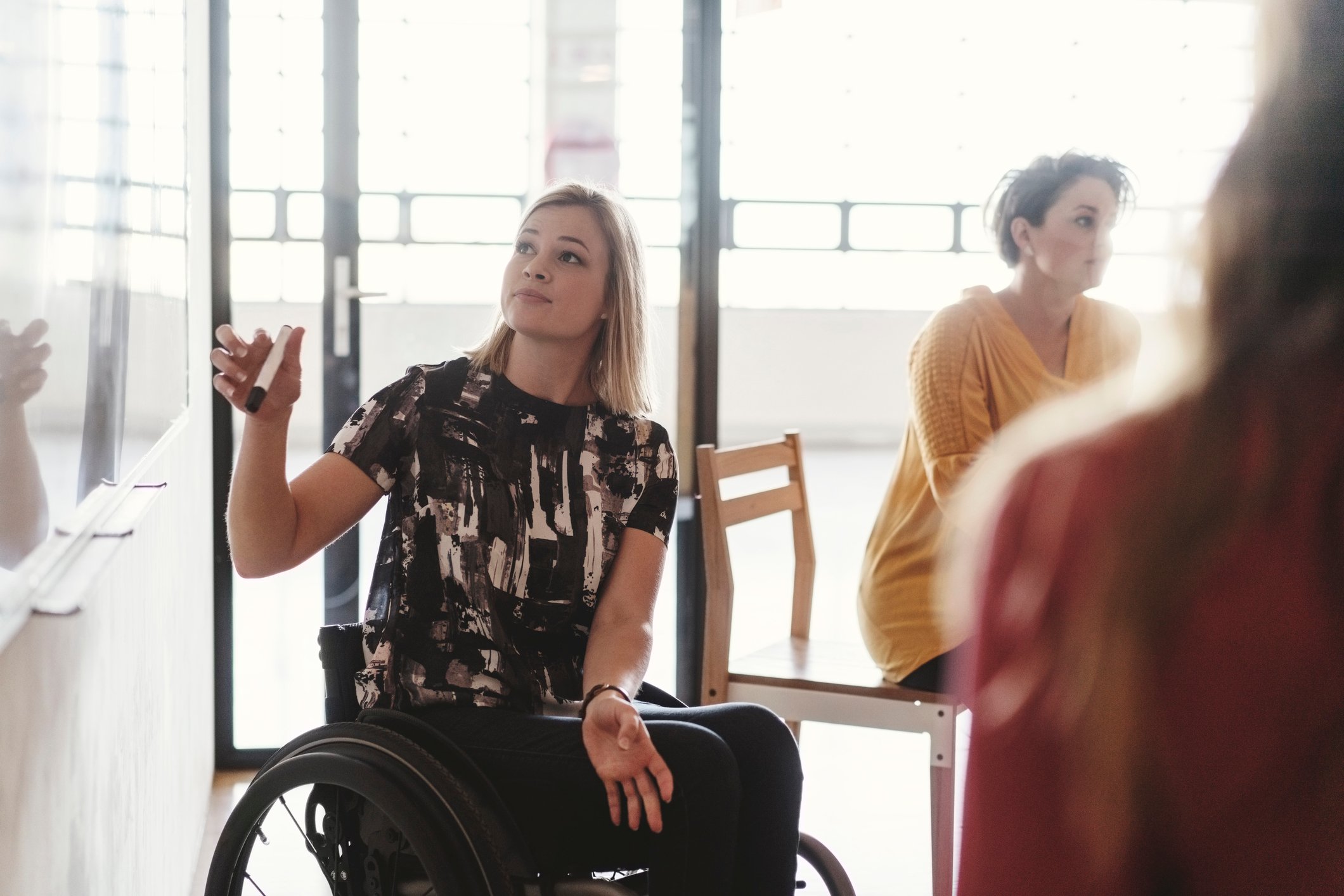
Person using a wheelchair giving presentation in office.
There’s a myth is that if you have enough women and femmes in your organization, your organization is automatically not sexist or femmephobic. This is absolutely untrue, especially if the only way for women and femmes to get ahead is to emulate men and masculinities.
When I talk about femininity and masculinity I am talking about what society has named “feminine” (E.g. nurturing, values relationships, connects to things emotionally) and “masculine” (lack of outward emotion, aggressiveness, places self above others).
Femmes are people who identify as a femme, usually because of some connection to prioritizing, appreciating, or embodying elements of what has been labeled “femininity.” Some femmes identify as women, some identify as men, some identify as nonbinary or genderqueer, some identify only as “femme.”
I’m a femme who has a lot of privilege in the work world due to my education and whiteness. I’ve realized that there are things I had been both consciously and unconsciously doing to fight back against the femmephobia I’ve experienced in activism and employment. Here are some of the things that I’ve done to push back when I can, and helped me to cope when I can’t.
Understand that “Professionalism” is Heteropatriarchal Rich White Ableist Bullshit.
So much of the trappings of professionalism are ways to enforce a rich white masculine norm. I’m not talking about being skilled at your job and doing a good job with your work.
I’m talking about things like making sure you don’t have wrinkles in your clothes, always having a smile on your face (which is usually only expected of women) and not being a person with emotions or a body.
My body is not professional. It sweats a lot, I need to drink so much water due to my medication that I go to the bathroom constantly, no matter how hard I try I always stain my clothes, and unless I’m wearing a turtleneck it’s almost impossible to keep my boobs from hanging out.
None of these things affect my performance at my jobs, yet they are still considered “unprofessional.” Think deeply about how we enact “professionalism” and who it is helping and who it is hurting.
See Emotions as Strengths not Weaknesses.
In the legal field, one of the worst things you can do as a woman is to cry in court. However, being able to empathize with others is actually a huge strength in most industries. Yet it is often devalued and almost never taught, aside from fields that are already gendered “feminine.”
In the legal field there are classes that teach women how to be more “self-confident,” yet there are rarely classes that teach men how to form and build relationships. This is especially galling when you think about the fact that most lawyers become “successful” because the relationships they have with their clients keep them coming back and referring people.
If you have the privilege and power to do so, you can help create space for people to be their full selves at work — emotions and all. Normalize being a whole person with feelings if you feel safe enough, whether that’s privately with coworkers or more publicly if you have supervisory power.
See, Acknowledge, and Compensate Emotional Labor
Lots of us do things at work that are not part of our job. Is there someone in your organization who always takes a new person under their wing? Is there someone that everyone goes to for advice? Make sure this labor is acknowledged and compensated.
While capitalism uses money to define how important different kinds of work are, people don’t work that way. It’s femmephobic to only acknowledge certain kinds of labor in the workplace. Acknowledge your coworkers emotional labor in difficult situations.
Even verbally appreciating a coworker for unseen work can make a difference. If you have power in the institution, make sure that this work is financially compensated because it is an important though unacknowledged part of things running smoothly.
Recognize that Dress Codes Reinforce Harmful Norms
Dress codes are problematic for so many reasons! They are classist, ableist, fatphobic, racist, and misogynist.
Many dress codes have different standards for “women” and “men,” which not only reinforces the gender binary, but also reinforces that women are supposed to look a certain (usually much more labor intensive) way than men. They also generally impede people’s ability to express their gender.
Fat femmes and other people with “nonconforming” bodies get especially fucked over in the dress code department because we have to work harder and spend more to find things that fit. We have to be careful that it’s adequately covering us up in ways thinner people do not have to consider.
A slightly low cut shirt may be fine for someone with smaller boobs, but if your boobs are larger it becomes “inappropriate” very quickly. So do what you can to abolish dress codes and question them (and violate them) whenever you feel you are able.
Don’t Be the Language Police
The most knowledgeable person in the room may use uptalk. The worker who has the most to offer may say “like” a lot. The smartest person in your company may use slang. Denigrating language styles that are overwhelmingly used by women and/or People of Color is sexist and racist.
Obviously some jobs require language to conform to (mostly arbitrary) standards. I have a casual way of speaking that uses a lot of internet speak and outdated slang (obvi, lulz, samesies, etc.). This often causes people to underestimate me. Think about the people you encounter on a daily basis and the assumptions you make about them based on language.
Capitalism is inherently femmephobic because it values the individual and competition over collective wellbeing and cooperation. While we are working to dismantle this cruel system we still need to eat and, for many of us, that means keeping a job.
For femmes, this often means days of microaggressions, unacknowledged emotional labor, and generally being underestimated and undervalued. Most of us don’t have the power to do much about it but hopefully recognizing the way femmephobia works can help us name these oppressions and find strategies for coping and resisting.
However, those of us with privilege or power in jobs, activism, art, or anywhere where these kinds of aggressions happen need to make changes towards a culture that values femininity as much as it does masculinity.
[do_widget id=’text-101′]
Katie Tastrom is an activist, writer, and lawyer. She writes about living with chronic illnesses, disability justice, fatness, parenting, queerness, bodies, and other stuff. She lives in Syracuse, NY with her four kids and amazing partner. She also watches a lot of TV. You can find more at katietastrom.com or follow her on Twitter at @katietastrom.
Search our 3000+ articles!
Read our articles about:
Webinars & Online Trainings
Our online racial justice training
Used by hundreds of universities, non-profits, and businesses.
Click to learn more