Source: The Manifest-Station
Originally published on The Manifest-Station and republished here with their permission.
At thirteen-years-old, I was a nerd. At thirteen, I was also beginning to struggle with my identity. I didn’t expect that my choice of dress would define my identity, just as I don’t think that Ahmed Mohamed expected his identity to be the topic of a trending hashtag.
#IStandWithAhmed was trending at number one worldwide as social media erupted with the story of a fourteen-year-old ninth grader in Irving, Texas being interrogated without his parents’ knowledge and arrested in front of his classmates. Ahmed had brought a homemade clock to school, but was accused by his teacher of the suspicious object being a bomb.
Despite claims of safety for the students, this wasn’t treated like an actual bomb threat. There were no lockdowns, evacuations, or a bomb squad to immediately remove the suspicious object from school grounds. When I read the article about the incident posted by Dallas News right before heading to sleep on the night of September 15, I was stunned.
I saw the picture of Ahmed being led away in handcuffs, his face a mixture of confusion and fear. He had been excited to share his invention with his teachers, adults that he trusted, educators that he looked up to. It was those same adults that should have been there to protect him against harm.
That look of anguish on his face was one that I felt reverberated through my body on my first day of eighth grade as a thirteen-year-old. It was the day I decided to come to school wearing a hijab.
I held the blue and cream-colored smooth material in my hands. Standing in front of the small mirror in my room, I double-checked my outfit – my favorite blue jeans, long-sleeved shirt, and new sneakers. I had spent a week planning this. The final touch felt heavy sitting in my hands. I spent another thirty minutes placing it perfectly on my head before running downstairs to meet my parents.
I ignored the worry on their faces. They assured me that they were proud of me for making this decision on my own, but they still believed I was too young. I reassured them that I had made plans with my best friends to meet me at the school’s main gates.
It was the first day of eighth grade, but I reminded myself that I had been attending the same middle school for two years. I wasn’t a stranger to the teachers or students. My dad dropped me off at the gates, where one of my friends had arrived early and was waiting to greet me.
She smiled, “I like it. You look nice. You still look like you.”
As we walked to our first class together, I couldn’t ignore the stares. I reached up to the blue and cream-colored hijab, making sure it was still sitting on my head.
I had heard a lot about my new English teacher. Students loved her and believed that she was the definition of a teacher that actually cared about each of her students. I was excited. Maybe this year I would learn to love writing.
My friend and I could hear the animated chatter of our peers, almost all of whom we had known for the past two years, if not more. As I entered the classroom, a hush fell over the students. All eyes were on me. My heartbeat rang through my ears, and yet still I could hear the whispers. The walk to our seats felt like eternity.
A part of me was scared. It wasn’t the whispers, looks, or even the snarky remarks that brought the rest of the students back to their lively chatter that worried me. It was the look in their eyes. Worse, it was the look in the teacher’s eyes that I wouldn’t forget.
Confusion, I could handle. Fear, I didn’t understand. How could they be afraid of me? It was the same look that Ahmed held in the trending picture of him being led out of the school in handcuffs.
Fear of the other or unknown existed long before September 11th. I learned this very quickly. Less than a month after walking into my first day of eighth grade as a visible Muslim, the horrific events of 9/11 tore through the heart of America.
I remember that morning, but what I tried to forget was the memory of teachers and students fearing my presence. I was thirteen and too scared to tell them that I, too, was mourning the loss of American lives.
Their fear wasn’t something I imagined. Nearing the end of the year, my English teacher gave us an assignment requiring us to ask others what words they would use to describe us. I jokingly asked my teacher how she would describe me, not expecting a serious response with students standing around. She put down what she was working on and looked at me, pausing for a few moments before she spoke.
“Honestly, I was worried when you walked into my class the first day of school. I thought, This girl must be a rebel. She’s going to cause trouble.”
Those first words almost caused me to miss the end of her answer when she went on to tell me point blank that she was wrong. Although she had asked my former teachers about me, she had come to know me as a student that was studious, hungry for knowledge and books, and respectfully quiet.
If she had been worried, how had the students felt?
After my first year wearing hijab, I knew what to expect when I started high school the next year. But I had hoped for different reactions from students and teachers. A teacher I enjoyed learning from waited until the end of the year, when a group of peers surrounded me to ask questions about my way of dress, to reveal that she was scared when I walked into her classroom.
It took months for her to feel comfortable around me because she, too, worried I would act up in class. It was in her class that I was unanimously voted as “Most Quiet.” I accepted the award with a smile and a sarcastic comment of how it’s always the quiet kids that were misunderstood.
Ahmed’s reaction to the consequences of his actions represented the innocence of his thirst for knowledge. While his father was clear that his Muslim name and skin color could not be ignored in this situation, Ahmed was not worrying about such details when he brought his invention to school. He was thinking like a kid. A bright student that was excited about what he had learned.
Choosing to wear a hijab meant that I would have to take into account my identity while in public.
I didn’t worry as much about wearing hijab. I worried about being expected to represent all Muslim women, Muslims, and Islam. I was aware of the fact that my family was the only Muslim family in the area and that I was the only Muslim student at school, from elementary through high school.
If I were going to represent Muslims against my control, then I would make it count. I threw myself into extracurricular clubs and activities. By the time I graduated, I was known by everyone at school and was even voted as “Most Studious” for High School Senior Stand-Outs. I was shocked that I was even nominated, but the support I received during the voting process was heartwarming.
Ahmed’s life changed when he realized that being black and Muslim would be challenging, but also lead to great blessings. This incident brought him invitations from top organizations and leaders nation wide.
My life changed when I experienced culture shock when I started at the UCSD. Suddenly, I was no longer the only Muslim student at my school. That still didn’t stop others from worrying about my background, as a Muslim.
As I continued on to higher education, I learned that I would not only be forced to defend my religion and choice of dress, but also my identity as an American. I am Muslim, but I was born and raised in this country. I am Muslim, and English is my first language. That didn’t stop students and professors alike from stereotyping me as someone who just landed in this country, with no grasp of the English language.
One undergrad professor expressed to me that it was obvious to her that my writing would reveal that I was struggling with being new to this country and the English language. This was before she had read any of my writing. Writing workshops in graduate school contained fellow writers that expressed their worry of a Muslim women writing Muslim characters, especially when they didn’t find any of the stereotypes they expected, about the religion or the culture.
Even as adult students, a few voiced before our graduation that some not only were afraid to approach me, some didn’t want to speak to me because the only Muslims they had ever seen were the ones on the news, painted to hate America. Just like the police officer reacted to the way Ahmed looked, I have had educators label me by their preconceived views of Muslims.
Fourteen years after that first day of walking into my English teacher’s classroom, that teacher has continued to be one of my favorite educators and a woman that my family and I highly respect. She has supported my writing and educational endeavors throughout the years. Just this past July, my family was honored to invite her into our home for a Ramadan dinner.
I know that Ahmed Mohamed will continue to gain support for his creative mind and I hope that he will gain lifelong mentors like the ones I gained throughout my education. Mentors who encouraged me to develop my skills and nourish my passions. This is what education in America should be for every student.
[do_widget id=’text-101′]
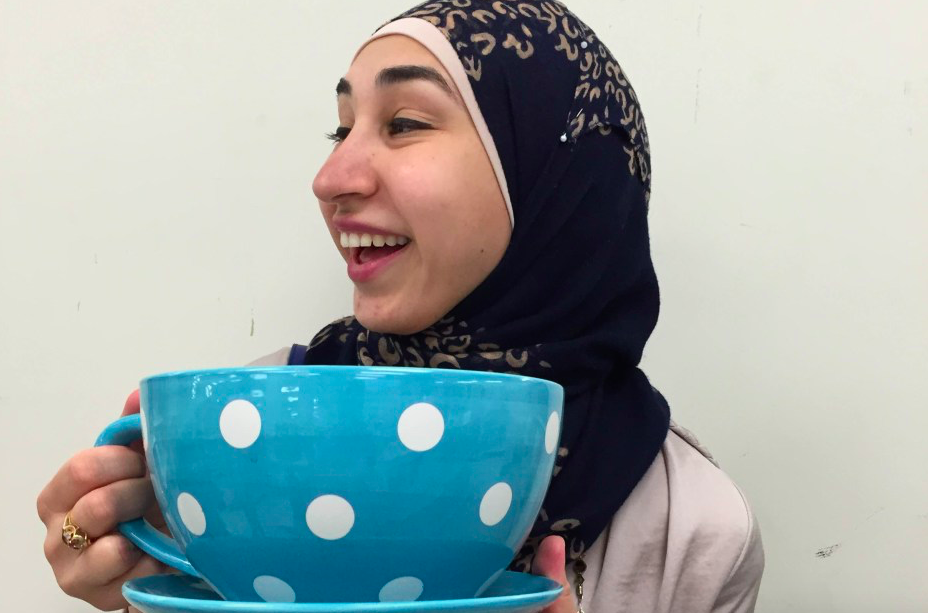
Haneen Oriqat is a writer and photographer as well as an alumna of UCSD and AULA. She writes about issues of gender, religion, and identity and spends most of her time with coffee in one hand and a good book in the other. You can find Haneen’s work on her website and follow her on Twitter @haneenoriqat.

Search our 3000+ articles!
Read our articles about:
Webinars & Online Trainings

Our online racial justice training
Used by hundreds of universities, non-profits, and businesses.
Click to learn more